
Your Travel Companion in Cape Town
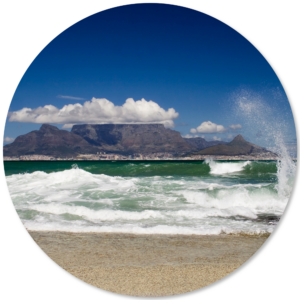
A SHIPWRECK AND A HEDGE
My visitors from overseas often want to hear about the history of the Cape.
It’s tempting to keep it very simple; the Dutch arrived in 1652, established a farm to provision their ships and brought ‘civilisation’ to Southern Africa. But, of course, if there is time for the telling then our history is rich in more detail.
As much as 100 000 years ago people we call the Khoisan migrated from the north into the Cape. No doubt climate change influenced this migration into an area offering not only a warm climate and reliable rainfall but vast herds of wild animals.
These migrants were eventually divided into two very different groups. The San people would be seen in our eyes as primitive hunter-gatherers, living in caves and having great skill as hunters of the abundant game. They were remarkable for their stories and spiritual beliefs which they often expressed by creating artwork (paintings) on the walls of their caves. Contact with the culture of the San is possible through their stories told by the last survivors of these early people who exist today in the deserts of Botswana, where we call them the bushmen.
A particular story of the San people which I like is that, at the beginning of time fire was kept as a secret burning coal under the wings of an Ostrich. The San tricked the Ostrich into dropping the hot coal and escaped with the secret of fire for humanity.
The other group of indigenous people were the Khoi, who sometimes referred to themselves as the KhoiKhoi, meaning ‘the men of men’. Over the years since European sailors first made contact with the end of Africa the Khoi had proved to be welcoming and happy to trade. They had developed as nomadic herders measuring their wealth in the numbers of cattle they followed as they moved and grazed through the fertile, green countryside.
In 1647 a shipwreck changed the course of history in the Cape and was probably the start of the end of thousands of years of peace and harmony with nature enjoyed by the indigenous people.
The ship was the Nieuw Haarlem, sailing back to Holland from the Dutch colonies in the far east. It ran aground in Table Bay and fortunately many of its crew were able to reach the shore, where they were marooned for a year before being rescued. They were happy and relieved to find themselves in a place blessed with fresh water, abundant fish in Table Bay and the nearby river, a climate suitable for them to grow and harvest crops, and local people happy to help them and sell them meat.
One of the survivors kept a journal and when he returned to Holland he presented it to his employers, the all powerful Dutch East India Company, controllers of the sea route and trade between Holland and its colonies in the far East. He recommended the company should consider establishing a small settlement at the end of Africa to provision ships on the long voyage to and from the colonies.
In 1652 three vessels under the command of Jan van Riebeeck landed in Table Bay with 100 passengers, built a small fort on the seashore and established a first farm in the centre of what is now Cape Town. Today there is a lovely park in the centre of the city where this farm once was and it is called ‘The Company Garden’.
The Dutch quickly realised that they needed labourers to establish themselves and expand their farming activities but were disappointed to find that the indigenous people were not interested. The Khoi, with their cattle were what we might call independently wealthy and the San were living happily, taking from the environment what they needed.
Unfortunately the Dutch also found that the previously welcoming Khoi had habit of ‘gathering up’ (poaching) farm animals as they followed their grazing herds through the area between the mountain and the sea and so Governor van Riebeeck came up with a plan to form a boundary around the area he wished to farm to keep out the Khoi (early apartheid perhaps?). In an arc from Table Bay to the rear of Table Mountain he formed this boundary by planting a ‘hedge’ made up chiefly of Wild Almond trees. These extraordinary trees have contorted, twisted branches growing close to the ground. They are certainly an impenetrable barrier through which to smuggle animals. Historians doubt whether van Riebeeck’s hedge was successful and over time it was uprooted but a remnant can be found, hidden away a corner of Cape Town’s jewel, the vast and scenic Kirstenbosch Botanical Gardens. There you can see the that the Wild Almond trees are both remarkable and impenetrable. Van Riebeecks hedge was an interesting idea, perhaps ahead of its time!
Get a front-row seat to John’s storytelling journey. Sign up now to get sneak peeks of upcoming chapters. And be the first to know when Tales from the Driver’s Seat goes to print.
Copyright © 2026 Kestrel Services
Copyright © 2026 Kestrel Services