
Your Travel Companion in Cape Town
DIAMONDS
In 1867 a group of children were playing a game with stones they had found on the banks of the Orange River near to a hot, dusty village called Hopetown, far to the north of Cape Town. One of the boys, Erasmus Jacobs, older and more curious than the others noticed that one of the stones was different, just white and heavy. It was shown to a friend and a traveller took it to the small farming town of Colesburg where one of the administrators, noting that this interesting stone could cut a pain of glass put it in an envelope and posted it to a man he knew to be interested in minerals.
It was, of course, a large diamond, 23 carats in size and it came to be known as the Eureka diamond, the first to be found in the vast hinterland of the Cape and was the start of the mining revolution which subsequently transformed Southern Africa. Erasmus Jacobs was not cheated, the importance of his find was recognised and although he did not pursue the possibility of finding more riverside riches he became a moderately rich farmer, his importance largely forgotten.
Two years later another much larger stone was found by an African shepherd. It weighed 84 carats and came to be called the first ‘Star of Africa’. This time it was as if a starting gun was fired and hordes of eager, greedy, desperate prospectors descended on an area which is today the large town of Kimberly. What of the poor shepherd? He was rewarded for discovering this stone of such extraordinary value, with 500 sheep, 10 oxen and a horse!
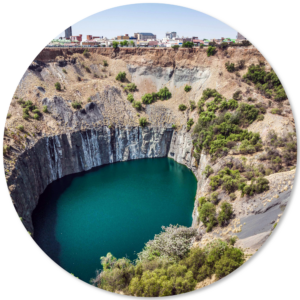
Meanwhile, far away across Africa a sickly young teenager, the son of an English vicar, was working on a cotton farm. He had been sent to the colony of Natal by his family who thought the warm African sunshine would be a help to him. This young man had shown some deal making talent on the farm and was ambitious. Hearing of the exciting things happening far away in Kimberly he borrowed some money from his aunt and set off by ox wagon across Africa to see what he could achieve. Arriving in Kimberly he found that the excitement was centered upon a large, extinct volcano. In the mouth of the volcano was a loose soil what was once lava and this soil, called Kimberlite, was studded with diamonds! In a few short years prospectors dug by hand what became the largest man made hole in the World, extending to a depth of over 200 metres.
The sickly young man was never going to actually dig anything. With his aunt’s loan he started buying and selling claims. He had a great talent. One of the claims was for a farm owned by Mrs de Beer. Cecil Rhodes became one of the richest men in the World and his company De Beers obtained for more than a hundred years a virtual monopoly on all gem diamonds sold in the World.
In my book I have extended this story to include tales of Cecil Rhodes’ great rival Barney Barnato, the vaudeville performer and prizefighter from the East end of London, and what happens when you follow the diamonds which came out of the volcano and were washed down the Orange River. They were not lost.
If you come travelling with me we can pass the time with these and other stories!
Get a front-row seat to John’s storytelling journey. Sign up now to get sneak peeks of upcoming chapters. And be the first to know when Tales from the Driver’s Seat goes to print.
Copyright © 2026 Kestrel Services
Copyright © 2026 Kestrel Services