
Your Travel Companion in Cape Town
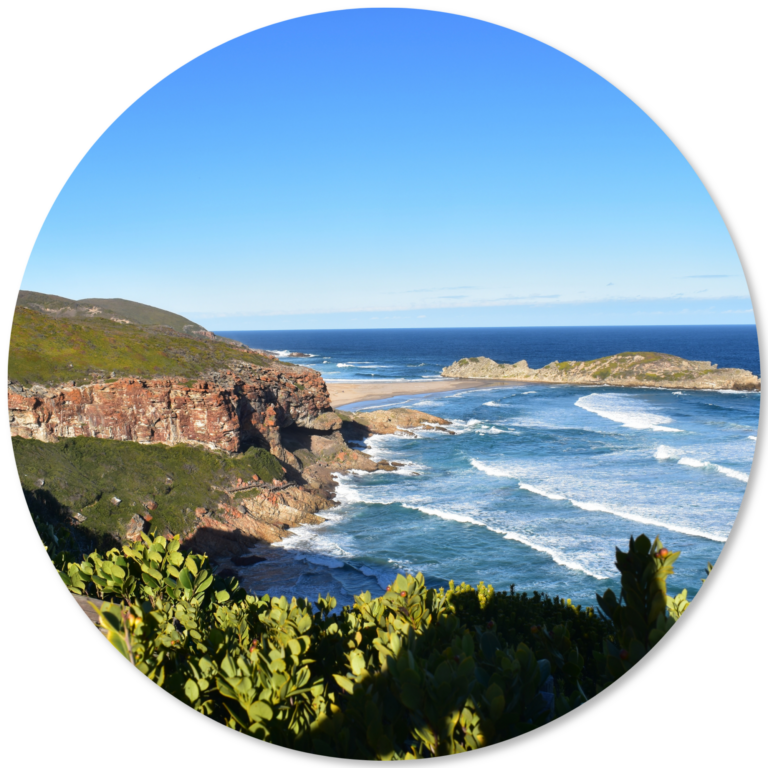
The Garden Route
Driving about 5 hours from Cape Town through rolling farmland brings us to the Garden Route, an area of great beauty between the Indian Ocean and forested mountains running beside dark peaceful lagoons. The name owes nothing to any actual gardens; it simply reflects the peaceful beauty of the region, once home to some of the earliest humans who lived in coastal caves, hunting game and foraging for seafood.
In time these indigenous peoples began recording, on the walls of their caves, images of the animals they saw and hunted. Deep in the forests they would have encountered elephants, memorably described by a local author, Dalene Matthee, as ‘ghosts in the trees walking the paths of their ancestors’ and as the ‘last great ones’. The nostalgia in these words reflects a great sadness which is one part of the history of the Garden Route. Deep in the forests beyond the beautiful town of Knysna the last elephants evaded humans with their guns and thirst for ivory but slowly died away. As I write this there is believed to be only one elephant left in the forests, its location a secret closely held by sympathetic rangers.
It was not just hunting which brought about this tragedy of the elephants, it was also due to the harvesting of thousands of valuable yellowwood and stinkwood trees in the area, pushing the elephants away from their habitat. The word Knysna comes from the language of the indigenous Khoikhoi people and it means place of timber. They, of course, lived in harmony with their environment, having no use for timber to construct dwellings, furniture and ships but when the European settlers came to the area they cut down the valuable trees and made their fortunes out of this ‘place of timber’.
The principal entrepreneur who came to the area to make his fortune had a fascinating legend about his background. His name was George Rex and he was reputed to be the bastard son of the English monarch, George 111, banished to South Africa under strict instructions to lead a quiet life and never have children who might become heirs to the British throne. Research has thrown doubt upon this story but George Rex was certainly a larger than life character. When he arrived in the undeveloped Knysna area he recognised the business opportunity but faced the problem that Knysna lies on a beautiful, tranquil lagoon cut off from the ocean by a narrow, dangerous channel between towering cliffs known as the Heads. The first boat commissioned to try and enter the lagoon was lost but not the second and in a short time a small harbour was established from which the timber could be exported and by means of which George Rex became very rich and slightly famous. Although he never returned to England it is just as well that he never lived out the legend of being denied children for he fathered 13, the first 4 with a former slave, Johanna van der Caap. I guess Queen Victoria would not have been amused.
Visitors to the Garden Route are often drawn to detour across the mountains towering over the town of George, known as the Outeniquas, which is an indigenous name of a lost tribe in the area known as the ‘they who bear honey’. Beyond the mountains is a very different but still scenic semi desert known as the Little Karoo and its key town is the Ostrich capital of Oudtshoorn. We will revisit the area in another chapter but let me tell you about the ‘ feather barons’. The Little Karoo and the area around Oudtshoorn was once the indigenous home to ostriches, those strange flightless birds which remind us of ancient dinosaurs. A business was established in the 19th century to farm these creatures. At that time in Europe and America there was a craze for ostrich feathers as a fashion accessory, so much so that the feathers became more than worth their weight in gold. Fortunes were made in Oudtshoorn by ‘feather Barons’ who flaunted their wealth and constructed extravagant mansions in the otherwise humble market town. Early in the 20th century with changing tastes and the coming of the motor car the wearing of extravagant feathered hats and garments quickly died and the fortunes of the Barons were gone like smoke. Today ostrich farming remains important on Oudtshoorn but we eat the excellent meat of the poor birds and sometimes buy feather dusters for our homes rather than put them in our hats.
When visitors come to Cape Town I always hope they will consider a little extra road trip to the magical Garden Route.
Copyright © 2026 Kestrel Services
Copyright © 2026 Kestrel Services